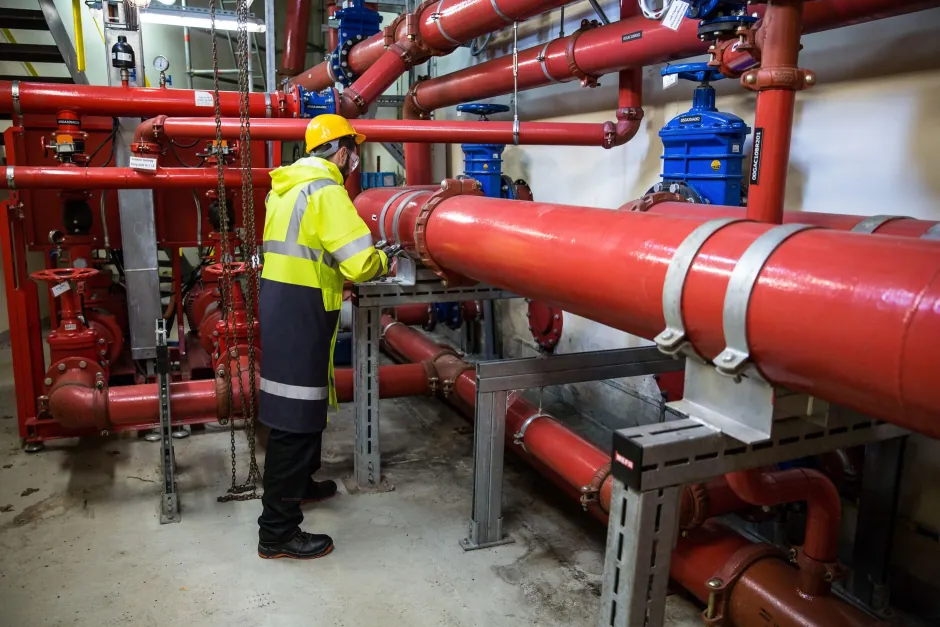
Traced with equipment rather than guesswork, because on ground that steps down toward the water the wet patch and the fault are frequently in different places.
Online Now!·--:--
A leak underground does not stay where it started. It leaves the pipe, meets ground that slopes, and travels along the fall until something stops it.
On a Como block that can be a long way. Properties here sit on ground that steps down toward the river, frequently below the road they front, and escaped water uses exactly the same fall the drainage was supposed to.
So the wet patch tells you where the water surfaced. It does not tell you where the pipe failed, and the two can be metres apart with retaining and paving in between.
Which is why we locate before we open anything. Meter test, acoustic listening and pressure isolation, worked uphill from the symptom rather than down, so one hole finds the fault instead of two holes finding nothing.


That is water going somewhere. On a sloping block it is worth finding quickly, because it is travelling rather than sitting.
Water leaves the pipe and follows the slope until it meets something that stops it: a retaining wall, a change in soil, a paved edge.
So the visible sign is where it surfaced. Working uphill from it is how you find where it actually escaped.
Digging under the wet patch on flat ground is often close enough. On a fall it frequently is not, and a wrong hole through retaining or paving costs real money to make good.
Locating first is cheaper than excavating twice, by a wide margin.
Where a property sits below the road, or where levels step across the block, escaped water can travel toward the building.
That is why we treat a leak on this ground as urgent even when the volume looks modest.
The meter, with everything off, to confirm water is genuinely moving. Acoustic listening to pick the line up under hard surfaces. Pressure testing to isolate which line is losing.
None of that involves opening anything, and it is what turns a search into a location.
Sydney Water may grant a hidden leak allowance once a licensed plumber has repaired a leak that was genuinely hidden.
They ask for the plumber's business name, ABN, phone and licence number along with the invoice. Ours carries all of it as a matter of course.
Quoted at a fixed price before anyone starts. These are indicative 2026 ranges, and the location work is priced separately so you are not paying to dig speculatively.
Meter, acoustic and pressure testing, worked uphill from the symptom.
Once exposed, depending on depth, material and what sits above it.
Including checking the others, because they are all the same age.
Water off, the leak isolated and the property stabilised, at any hour.
What failed and where, in a form Sydney Water will accept with an allowance request.

If it is a burst, we tell you how to stop it at the meter before we leave, so the damage stops while we are on the way.

Meter, acoustic listening and pressure testing, worked uphill from where the water showed.

One access point at the fault rather than a trial hole under the wet patch.

What failed and where, with the licence number and ABN Sydney Water asks for if you apply for an allowance.
Turn it off at the meter and call. A licensed plumber can be on the way, 24/7, and we will talk you through stopping it while we drive.
Call 1300 381 569
Often not, and on a block with any fall you should assume it is not until somebody has checked. Water leaves the pipe, meets ground that slopes, and follows the fall until something stops it. So the visible wet patch marks where the water surfaced, not where it escaped, and those can be a long way apart. Digging under the wet patch is how people end up with two holes and the same leak.
By narrowing it before opening anything. The meter tells us whether water is moving with everything off. Acoustic listening picks the pipe up under hard surfaces. Pressure testing isolates which line is losing. On a sloping block we also work uphill from the symptom rather than down, because the fault is almost always above where the water shows.
Turn the water off at the meter, before anything else. Then keep water away from anything electrical and do not go paddling near power. On a block that steps down, move what you can out of the lowest room in the house, because that is where the water is heading.
Because the ground decides, not the pipe. Where a property sits below the road, or where levels step across the block, escaped water travels along the fall and can arrive at the building rather than leaving it. It is one of the reasons a leak on ground like this gets expensive quickly, and it is why we treat one as urgent even when the volume seems small.
Possibly. Sydney Water may grant a hidden leak allowance once a licensed plumber has repaired one, and it is worth asking about. It applies to leaks that were genuinely hidden, so a visible wet patch or consistently damp ground would usually not qualify. Either way we put the licence number and ABN on the invoice, which is what they ask for.
Yes, and sooner on this ground than on flat ground. A small continuous leak on a slope has somewhere to travel, and water moving through fill and around retaining is doing something you cannot see. The repair is small. What the water is quietly doing to the ground around it is the part that is not.
Detection and location is $250 to $550, which includes narrowing it down properly rather than guessing. A burst repaired once it is exposed is $350 to $900 depending on where it sits. A failed flexi hose replaced is $180 to $350. We give the figure before we start.
Tell us where the water is showing and which way your block falls. On this ground those two things together are most of the diagnosis.
Located before anything is opened, fixed price agreed first, and written findings you can use with Sydney Water.
Online Now!·--:--